
Meet the Beekeeper
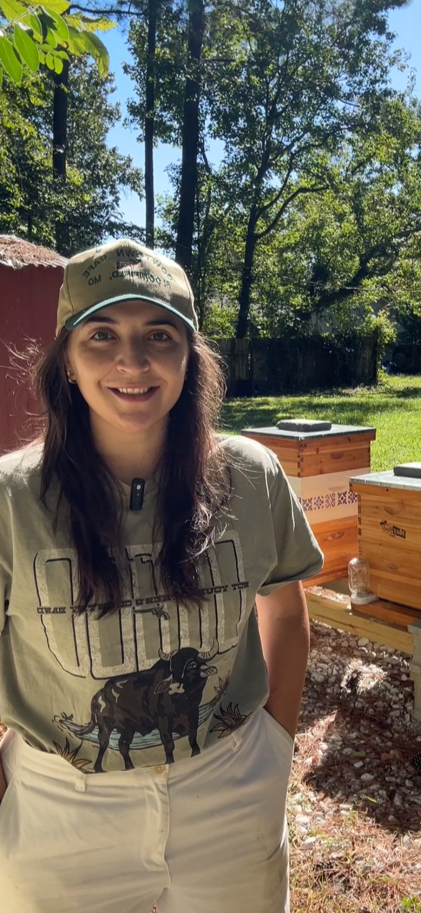
Hi, honey child. I’m Casey, the entomologist and beekeeper behind Honey Child Hives.
At the heart of Honey Child Hives is something I believe deeply:
You should not have to become a beekeeper to feel connected to a colony.
Honey bees offer us an entire world to discover. Whether you host a hive on your property, follow one from afar through The Hive Club, or simply learn something that changes the way you see the bees outside your window, Honey Child Hives is about bringing that world a little closer.
Honey bees first found their way into my life more than a decade ago while I was working in an insect research lab at Virginia Tech. Alongside our usual work with squash bugs and brown marmorated stink bugs, I helped with a research project studying honey bee behavior and productivity. I spent that summer tending colonies, collecting data, and working in the university apiaries. I was hooked, like the tiny hamuli that hold a bee’s wings together.
Honey bees stayed with me as I earned my master’s degree in entomology and built a career in agriculture, education, and public service. Over the years, I have cared for colonies at Virginia Tech, NC State, and in apiaries of my own. When my position with the U.S. Department of Agriculture was eliminated during the 2025 federal reduction in force, I decided to find possibility in the unexpected. Honey Child Hives is part of what grew from it.
What keeps me coming back? Cracking open a hive, hearing the propolis pop, and being greeted by thousands of bees, all moving, all busy, and all with a purpose. No matter how many times I experience it, the life unfolding inside a honey bee colony still feels extraordinary.
My approach to beekeeping is equal parts science, stewardship, curiosity, and heart. It is grounded in my background as an entomologist, more than a decade of hands-on experience, and the belief that good beekeeping means never assuming you know it all. I stay curious, keep learning, and care for each colony with careful attention to the bees and the environment around them.
And while I take that responsibility seriously, I am a little rougher around the edges than your average Southern belle. I talk to my bees. I sing to them. I call them my girls. And if I spot a queen doing exactly what she is supposed to be doing, there is a very good chance she is going to hear, “Go off, queen!”
That is Honey Child Hives: a little science, a little Southern charm, and a whole lot of love for the bees.
Let’s Talk Bees
Whether you’re curious about hosting a hive, interested in The Hive Club, or simply want to learn more or connect, I’d love to hear from you.